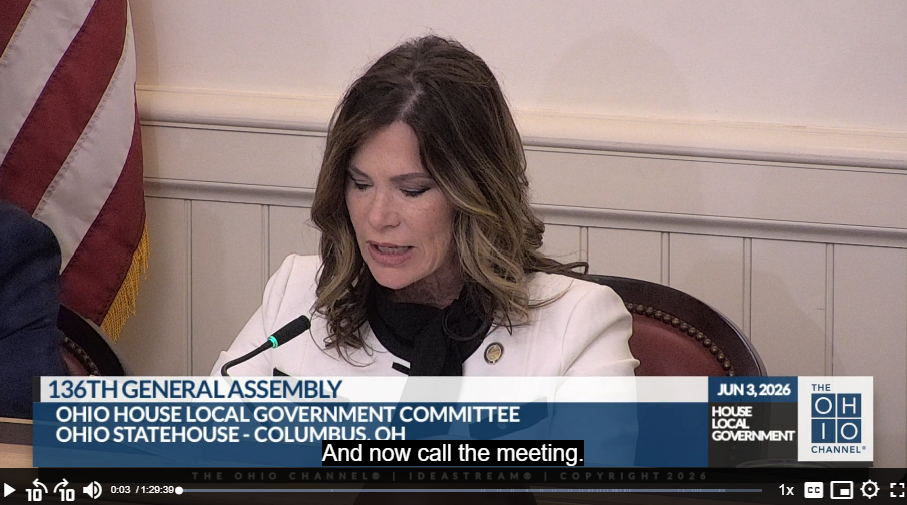
Wednesday June 3, 2026 John Kalas and Skip Claypool gave testimony in support of HB 445. HB 445 in Ohio is designed to bring a more balanced representation to MPO’s. NOACA as an example has a board that is controlled by a Cleveland/Cuyahoga County Super Majority. That creates all kinds of issues for the 4 ring counties. Projects are not funded in the ring counties and all monies are funneled into Cleveland/Cuyahoga County. Listen to the testimony in this location. The testimony begins around 53 minutes. Click HERE to go directly to the house website.
The following is a copy of the text of Skip’s testimony.
In Support of HB 445
6.2.2026
Author: Skip (Walter) Claypool
Private Experience: Business Executive
Government Experience: County Commissioner, Township Trustee, Mental Health Board, Planning Commission, Metropolitan Housing Authority, NOACA Board Member.
Chairman, Vice Chair, Ranking Member, and members of the committee:
Thank you for the opportunity to testify in support of House Bill 445.
For more than a decade, I have been involved with NOACA, serving as both a commissioner representative and alternate on the board. I have participated in numerous transportation studies, planning initiatives, and public meetings. My testimony is based on direct experience observing how MPOs operate and the impact they have on local governments and taxpayers.
In 2017, I led an effort to evaluate separating Lake and Geauga Counties from NOACA and forming a new MPO. Working with assistance from ODOT, I developed a financial model showing that separation could provide significant financial and other benefits to both counties. Political considerations ultimately stopped the effort, but the analysis demonstrated that alternative MPO structures are both practical and achievable.
The first point I would like this committee to consider is that MPOs are not indispensable to transportation planning in Ohio. Ohio has 17 MPOs involving portions of only 32 counties. That means 56 Ohio counties are not in an MPO. Those counties continue to maintain roads, bridges, and transportation infrastructure through existing state and local processes. While MPOs are a reality under federal law, they should not be viewed as untouchable institutions beyond reform.
Second, federal law does not prevent Ohio from imposing additional accountability and governance requirements.
MPOs are authorized under federal transportation regulations 23 CFR 450.310. However, federal law does not dictate many of the governance decisions that MPOs claim are required such as membership by population. Federal law also provides mechanisms for adjusting MPO boundaries and creating new MPOs when circumstances warrant. Ohio has the authority to follow federal guidance and to establish safeguards that better protect local governments and taxpayers.
Third, many MPOs have expanded far beyond their intended transportation mission.
Federal law establishes MPOs to conduct “metropolitan transportation planning.” Yet organizations such as NOACA have increasingly engaged in climate action planning, regional development initiatives, land-use planning, and other activities that many local officials believe fall outside their core purpose.
NOACA and other MPOs in Northeast Ohio participated in a multi-million-dollar HUD-funded regional planning effort. Taxpayers have a right to ask why transportation planning organizations are devoting significant resources to activities unrelated to maintaining roads, bridges, and transportation infrastructure.
Finally, governance and representation remain serious concerns.
The original agreement/contract creating NOACA provided equal representation among 7 member counties. Two left NOACA due to political strife. Over time, that balance of power changed dramatically. Today, Cleveland and Cuyahoga County hold a super majority and dominant voting position, while surrounding counties have substantially less influence over decisions affecting transportation funding and policy.
This imbalance has contributed to frustration among local officials and residents who believe their tax dollars are supporting priorities they neither control nor support. Regardless of one’s political views, transportation funding decisions should be transparent, accountable, and reflective of all participating communities.
House Bill 445 is an important first step toward restoring accountability to MPOs and ensuring they remain focused on their primary mission. Organizations that exercise significant influence over transportation funding should be subject to meaningful oversight and balanced governance. That oversight does NOT exist today.
I respectfully urge the committee to support House Bill 445 and continue exploring reforms that strengthen local representation, improve accountability, and ensure transportation dollars are spent on transportation priorities.
Thank you for your time and consideration.